
Our certified marine lithium battery is here: the SOK 24V 150Ah Marine
by Sogen Energy||Marine|3 min read
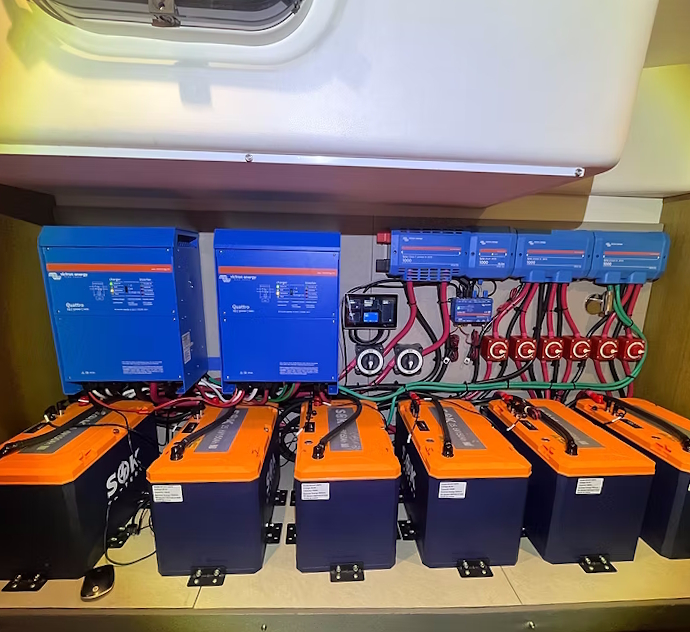
Every boat owner looking at lithium gets asked the same question sooner or later. By the surveyor, the insurer or the marine electrician.
"Is it certified?"
For a lot of the lithium batteries sold for boats in NZ, the honest answer is no. So we went and got ours certified.
The SOK SK24V150PH-Marine is a 24V 150Ah LiFePO4 house battery, tested and certified to AS/NZS 3004.2. It's in stock in New Zealand and on sale now.
What AS/NZS 3004.2 actually is
AS/NZS 3004.2 is the standard for electrical installations on boats in New Zealand and Australia. It's what your marine electrician works to and what a surveyor checks against.
The Marine battery was tested by an Auckland lab, and the test report is issued under its own model number. That matters. A certificate for "a similar battery" doesn't help you when an insurer asks what's actually fitted to your boat.
Every battery comes with a copy of the certificate, so you or your electrician can hand it straight over. You can also read the certification report (PDF).
The numbers

- 24V nominal, 150Ah, around 3.8kWh per battery
- 200A continuous discharge per battery
- 500A surge for 10 seconds
- LiFePO4 chemistry (lithium iron phosphate, the stable one)
- Around 30kg, 435 x 240 x 276mm, IP67 rated
- Talks to a Victron GX over CAN, and to your chartplotter over NMEA 2000
- Bluetooth to the SOK Battery app for cell voltages, temperatures and alarm history
- 7 year warranty
- RRP $3,450 inc GST
Need more capacity? Connect them in parallel. 4 batteries gives you a bank of roughly 15kWh at 24V, enough to run fridges, freezers, nav gear and an inverter for days at anchor. You can go up to 15 batteries, and the whole bank reports to your Victron system as one battery.
It's built for 24V systems. It's not designed to be wired in series to make 48V.
Two features that matter more on a boat than in a house
At home, if your battery shuts off, the lights go out and you go to bed. On a boat, a battery shutting off without warning can take your nav, pumps and comms with it.
So the Marine version has 2 things the standard battery doesn't:
A low voltage pre-alarm. A buzzer sounds before the battery reaches its low voltage cut-off. You get time to start the genset, fire up the engine or shed some load. No surprises halfway through the night.
A bank disconnect output. If the battery detects a fault, it sends a signal your electrician can wire to disconnect the bank. It's a controlled shutdown of the system, rather than each battery quietly switching itself off.
Who it's for
We built this range for bigger boats on 24V systems: launches and yachts from around 50ft, right up to superyachts.
If you're replacing a tired AGM house bank, the weight saving alone is worth a look. You also get far more usable capacity from the same rated amp-hours, and a battery that doesn't mind sitting part charged. Our LiFePO4 vs AGM guide runs through the numbers.
Installation
This needs to go in properly. The Marine battery has specific installation requirements, and they're part of the warranty.
We don't install. Your marine electrician does. The user manual (PDF) covers the safe-practice guidance, and we supply the AS/NZS 3004.2 certificate with every battery. Your electrician handles the install and your inspector or surveyor signs it off.
And if your electrician has questions about the BMS, comms or setup, they can call us direct. That's the bit I spend most of my day on.
Where to get one
The SK24V150PH-Marine is in stock now. You can order it from the SOK 24V 150Ah Marine page, where you'll also find the full specs. If you or your marine electrician want to talk through a bank size or a changeover from AGM first, get in touch.
Brendon
Written by
Sogen Energy
Lithium batteries and off grid power systems, held in stock in Nelson and shipped throughout New Zealand.