
Solar and Battery Storage for NZ Farms
Power your sheds, pumps and essentials with solar and battery storage built for farm life.
Solar on a farm isn't about chasing a green badge. It's about keeping water moving, sheds running and the power on when the lines go down, without paying a fortune to trench power to every corner of the property.
More and more farmers and lifestyle block owners across New Zealand are looking into it. The panels are cheap now, but the real game changer is battery storage. Panels only make power when the sun's out. A good LiFePO4 battery lets you use that power at night, on a cloudy week, or when the grid drops out in a storm.
This guide covers where solar and batteries actually earn their keep on a farm, how to size a system without getting lost in the jargon, and the mistakes we see people make most often.
Where solar earns its keep on a farm
The best farm solar jobs are the ones where getting grid power there is expensive, or where losing power costs you money. On most properties that comes down to three places.
- Sheds and outbuildings. Workshops, implement sheds, calf sheds and tack rooms that are a long way from the house. Running a cable or a new transformer out there can cost more than a solar and battery setup.
- Water. Bore pumps, trough pumps and header tank top-ups. Stock need water every day, sun or no sun.
- Backup power. Keeping the essentials going when the lines are down, whether that's the house, the freezers, the milk vat chiller or the comms.
If one of these is a headache on your place, that's where to start. You don't need to power the whole farm on day one.
Solar water pumping with battery storage
A solar pump with no battery only pumps while the sun is shining. That's fine for filling a big storage tank on a sunny day, but it falls over in a run of grey weather, or when you need pressure at 6am.
Adding a battery changes that. The panels charge the battery during the day, and the pump runs off the battery whenever it's needed. You get water on demand, steadier pressure, and you can size the pump for the job rather than for how bright it is outside.
This setup works well for:
- Bore pumps feeding a house or stock water system
- Trough and header tank top-ups on remote blocks
- Pressure pumps where you want water at the tap any time of day
The other bonus is you're not locked into one pump. The same battery can run lights, a fence energiser, a gate opener or a camera in the same shed.
Backup power when the lines go down
Rural power cuts tend to last longer than in town. A storm takes out a line up the valley and you can be waiting a day or more. That's when the freezer starts to thaw, the water stops, and the milk in the vat is at risk.
A battery system set up for backup switches over when the grid drops out, so your essential circuits keep going. Pair it with solar and it recharges itself during the day. If a long grey spell runs the battery down, our Energy Hub cabinets can auto start your generator to top it up, then shut it off again, so you're not out in the rain at midnight pulling a starter cord.
The trick is deciding what actually needs to stay on. Most people don't need the whole house, just the essentials:
- Fridges and freezers
- Water pump
- Lights and a few power points
- Internet and phone charging
- Milk vat chiller or other critical farm gear
Picking your essential circuits keeps the system smaller and the cost down.
Sizing a system in plain English
You don't need to be an electrician to get a rough idea of what you need. Work through it in this order.
- List what you want to run. Write down each item, its power rating (in watts, usually on the label) and how many hours a day it runs.
- Work out your daily use. Watts × hours = watt-hours. Add them all up. A 1,000W pump running 2 hours is 2,000Wh, or 2kWh.
- Decide how many days of backup you want. Two days covers most bad-weather spells. Multiply your daily use by that number to get your battery size.
- Size the panels for winter, not summer. Winter is when you get the least sun, so that's the month to plan for. Divide your daily use by your area's winter sun hours, then add some headroom.
- Check the inverter. It needs to handle the biggest thing you run at once, plus the extra kick a pump motor needs to start.
Example (rough numbers for illustration): a bore pump using 2kWh a day plus a freezer and lights using 1.5kWh comes to 3.5kWh a day. Two days of backup means about a 7kWh battery. With around 2.5 hours of winter sun, you'd want roughly 1.5 to 2kW of panels.
Every site is different, so treat this as a starting point. Our battery size calculator does the maths for you, or send us your list and we'll help work out your needs.
Why a pre-wired cabinet beats a box of parts
A lot of farm systems get built from a pile of parts bolted to a shed wall. It works, until something goes wrong and nobody can work out what's wired to what.
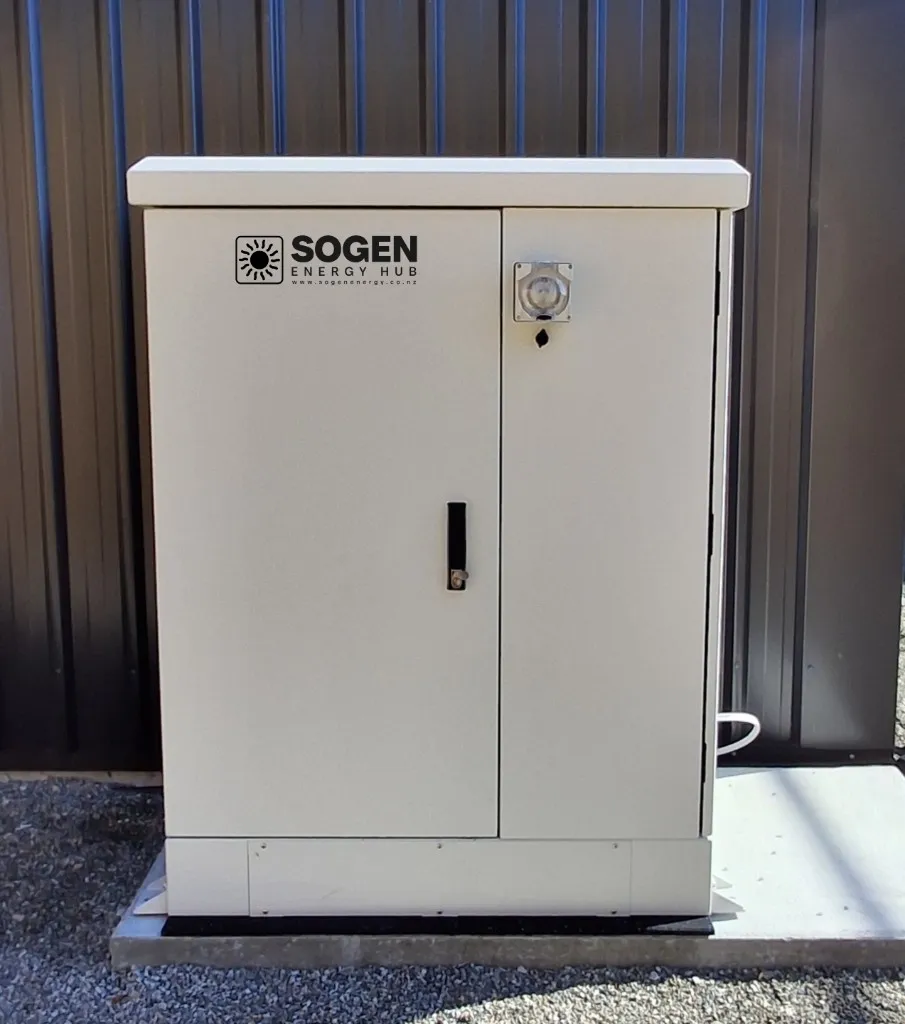
Our Energy Hub cabinets come pre-wired and tested before they leave us. The SOK battery, inverter, solar charge control and protection are all housed in one tidy unit. That means:
- Faster installs. Each cabinet arrives with an electrical Certificate of Compliance. Your electrician connects it up rather than building it from scratch.
- AC in and AC out. Feed it from the grid or a generator, and run your 230V gear straight off the AC output.
- Generator auto start. When the battery gets low the cabinet starts your generator, charges up, and shuts it down again. No running out to the shed.
- Safer. Everything is protected and fused properly inside a closed cabinet, out of reach of kids, dogs and stock.
- Built for the conditions. Both cabinets are outdoor rated to IP54+ against dust and water, so they can go on an outside wall or in a dusty shed. The Midi's 3mm aluminium cabinet is also lockable.
- Easier to support. Remote monitoring is built in, and if you ever need help, we know exactly what's inside.
We use LiFePO4 batteries because they're the safest lithium chemistry, they last thousands of cycles, and they don't need the babysitting that lead-acid batteries do.
- Energy Hub Mini for a single shed, pump or sleepout: 10kWh of storage on a 6kW GoodWe hybrid inverter, with 32A plug-in AC in and out. The Mini Pro adds a cellular modem and external antenna for sheds with no Wi-Fi.
- Energy Hub Midi for the house and the bigger farm loads: 10 to 30kWh with 5 or 8kVA Victron inverters, a 32A generator input and two wire auto start.

Common mistakes we see
- Sizing for summer. A system that's great in January can run flat in July. Always plan for winter.
- Forgetting pump start-up. Pump motors pull a big surge for a second or two when they kick in. An undersized inverter will trip every time.
- Skimping on the battery. Cheap batteries with no proper BMS (the battery's built-in brain) are a false economy, and a fire risk in a shed full of hay.
- Long cable runs on low voltage. Running 12V a long way loses a lot of power in the cable. Keep the battery close to what it powers, or go to a higher voltage.
- No plan for growth. Pick a system you can add batteries or panels to later, so you're not starting again when the farm grows.
- DIY without a sparky. Anything connected to your house or 230V wiring needs a registered electrician to sign it off.
Planning a long cable run out to a shed or pump? Check it with our voltage drop calculator.
Farm solar FAQ
Yes. With a battery in the system you can run it any time, not just when the sun's out. The key is matching the inverter to the pump's start-up surge.
Often, yes, for outbuildings far from the house, and for backup during outages. It also cuts what you buy from the grid.
SOK LiFePO4 batteries are rated for 3,000 to 8,000 charge cycles, which is well over 10 years of daily use. Our 48V rack batteries, including those in Energy Hub cabinets, carry a 10 year warranty, and our 12V and 24V batteries carry 7 years. See our warranty terms.
Yes, for anything connected to 230V or your house wiring, and for connecting solar arrays over 120V DC. Our cabinets arrive pre-wired with an electrical Certificate of Compliance, so that job is quick and simple.
Yes. Start with the shed or the pump that's giving you grief, and expand when you're ready. The Energy Hub Midi takes 2 to 6 SOK rack batteries, so you can add storage as you go.
Talk to us about your place
Every farm is different. Tell us what you want to run and where, and we'll help you work out the right system. Or call us on 022 502 2377.