
Volts, amps, watts and kWh explained with water
by Brendon Shervell||Solar basics|9 min read
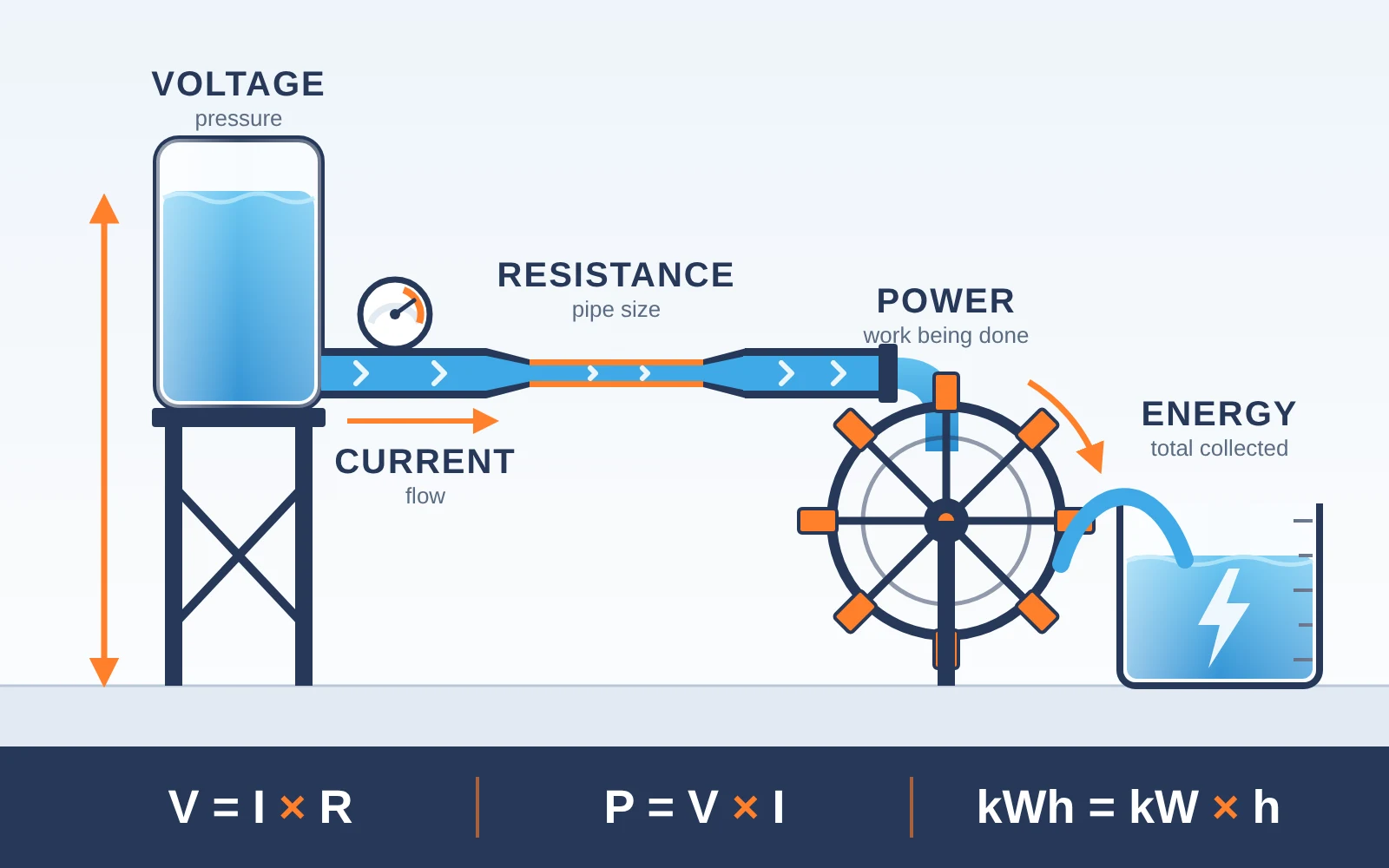
You don't need to be an electrician to understand energy.
Electricity feels confusing because you can't see it. Volts, amps, watts, kilowatt hours. They get thrown around in every quote and spec sheet, and hardly anyone explains them in a way that actually sticks.
Water is different. We all know what pressure feels like. We know the difference between a trickle and a flood, and between a bucket and a header tank.
So that's how I explain it to customers, and that's what this post does. Once you can picture electricity as water, solar and batteries stop being a mystery, and you'll be able to tell whether the system you're being sold actually makes sense.
The whole idea on one page
| Water | Electricity | What it means |
|---|---|---|
| Height of the tank (pressure) | Voltage (V) | The push |
| Flow rate | Current (amps, A) | How much is moving |
| Pipe size and blockages | Resistance (ohms, Ω) | How hard it is to flow |
| Work done by a water wheel | Power (watts, W) | How hard it's working right now |
| Total water used | Energy (kWh) | How much you used over time |
Let's go through them one at a time.
Voltage is pressure
Put a water tank on a stand and the higher it sits, the harder the water pushes out of the tap. Voltage is exactly that. It's electrical pressure.
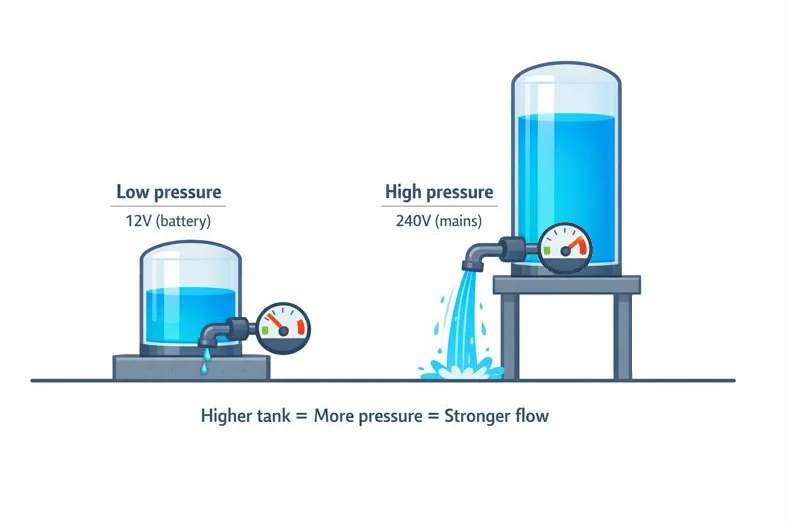
| Item | Voltage | Like a... |
|---|---|---|
| AA battery | 1.5V | Small bucket |
| Car battery | 12V | Header tank |
| Home battery system | 48V | Tank on a tall stand |
| House wall socket | 230V (often still called 240V) | Town water tower |
| Local power lines | 11,000V+ | Hydro lake |
Here's why it matters for you. Higher voltage moves the same power with less current. That's why home and off grid systems run at 48V rather than 12V. Less current means thinner cables, less heat and less power lost along the way. It's also why our 48V rack batteries are the go to for houses and farm sheds.
For a house that is connected to the mains or grid, you don't need to worry about it. The utility grid is 230V and your inverter matches it automatically.
Current is flow
Current is how much electricity is actually moving, the same way you'd measure litres per second through a pipe.
Same water pressure, but a garden hose and a fire hose move very different amounts of water. Same with appliances. Plug an LED light and a kettle into the same 230V socket and the kettle pulls 500 times more current.
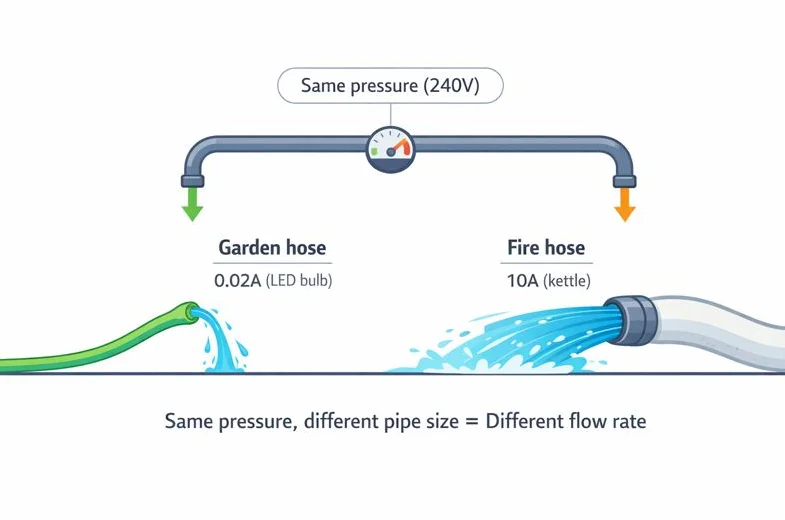
| Item | Current | Like a... |
|---|---|---|
| LED light | 0.02A | Dripping tap |
| Phone charger | 1 to 2A | Trickle |
| Kettle or hair dryer | 10A | Garden hose |
| EV charger | 30A+ | Fire hose |
Big flow needs a big pipe. That's why your oven has its own heavy circuit, and why battery cables on a 12V or 24V system are so chunky. Every one of those cables needs a fuse sized to match it too. If you're doing your own DC wiring, read our guide to calculating fuse sizes first.
Resistance is a narrow or blocked pipe
Push water through a long, skinny pipe and you lose pressure along the way. Electricity does the same. Thin or long cables fight the current, and the result is heat and lost voltage.
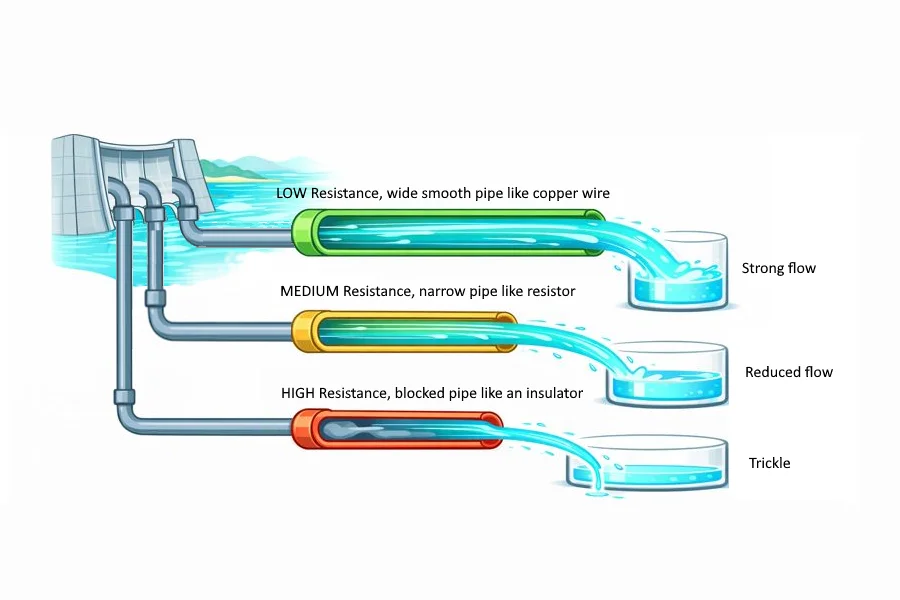
- Low resistance: thick copper cable. Easy flow.
- Medium resistance: thin or very long cable. Some of your power turns into heat.
- High resistance: rubber insulation. Nothing gets through, which is the point.
This is the number one mistake I see in DIY systems. Someone runs a long thin cable from the battery to the inverter, the voltage sags under load, and the inverter keeps shutting down. Before you buy cable, run your numbers through our voltage drop calculator.
Ohm's law ties it together
Pressure, flow and pipe size are all linked. Change one and the others move.
Volts = amps × ohms (V = I × R)
In water terms:
- More pressure, same pipe, gives you more flow
- Narrower pipe, same pressure, gives you less flow
- To push the same flow through a narrower pipe, you need more pressure
A quick example. A 12V car battery running a headlight with 4 ohms of resistance pushes 12 ÷ 4 = 3 amps through it.
You won't need this formula day to day. But it's the reason double the resistance means half the current, and the reason cable size matters so much.
Power is how hard it's working
Pressure on its own does nothing. Flow on its own does nothing. Put them together and you can spin a water wheel. That's power, measured in watts.
Watts = volts × amps (P = V × I)
So a kettle on 230V pulling 10A uses 230 × 10 = 2,300W, or 2.3kW.
| Item | Power | Like a... |
|---|---|---|
| LED bulb | 9W | Toy water wheel |
| Laptop | 65W | Garden water wheel |
| Microwave | 1,000W | Mill wheel |
| EV charging | 7,000W+ | Small hydro station |
Power tells you how big your inverter needs to be. If you want to run the kettle, the microwave and the water pump at the same time, add their watts together. That's the peak your inverter has to handle.
Energy (kWh) is the one that matters most
If you only take one thing from this post, make it this.
Your power bill charges you for energy (kWh), not power (kW).
Energy is power over time. It's the total amount of water that came out of the tap today, not how hard it was flowing at any one moment.
kWh = kW × hours
1kWh is 1,000 watts running for 1 hour, or 100 watts running for 10 hours.
A fire hose for 5 minutes moves a lot of water fast, but a garden hose left on all day ends up moving more. Same with your appliances:
| Appliance | Power | Hours a day | Energy a day |
|---|---|---|---|
| LED bulb | 9W | 8 | 0.07kWh |
| Fridge | 150W | 24 (cycling) | about 1.8kWh |
| Kettle | 2,300W | 0.25 | about 0.6kWh |
| EV charging | 7,000W | 8 | 56kWh |
The kettle is the big power user, but the fridge uses three times the energy because it never stops.
This is why you size a battery and a solar array in kWh. Use our battery calculator to add up what you run and it'll tell you how many kWh a day you actually need.
Same panels, very different energy
Here's where solar catches people out. A 5kW solar array might make around 25kWh on a good January day. The same array on a dull June day might make 7kWh or less.
Same panels. Very different energy. Winter is the problem for solar, and panel size alone doesn't tell you the whole story.
Solar panels are pumps that run on sunlight
Think of your panels as a water pump that only runs when the sun shines.
| Time of day | The pump is... | Output |
|---|---|---|
| Dawn | Starting slowly | About 10% |
| Midday | Flat out | 100% |
| Dusk | Slowing down | About 20% |
| Night | Stopped | 0% |
A few things follow from that:
- Panels don't store anything. They only pump while the sun is out.
- Adding more panels does nothing at night. Zero times anything is still zero.
- In winter the pump runs slower and for fewer hours.
So if your system has to work in winter, size your solar for June, not January. Your solar charge controller has to match the array too. Our guide to MPPT charge controller sizing walks through it.
Batteries are storage tanks
A battery is the tank. The solar pump fills it during the day, and you drain it at night.
- Morning: tank at about 30%
- Afternoon, after a sunny day: tank at about 90%
- Next morning, after running the house overnight: back down to about 20%
Batteries shift energy in time. They don't create it.
I hear this one a lot: "A bigger battery will fix my winter problem." It won't. If the pump barely runs in June, a bigger tank just sits there half empty. A winter shortfall is fixed with more solar, using less, or a generator for the grey weeks. Not a bigger tank.
What kind of tank matters as well. A lithium (LiFePO4) battery lets you use nearly all of what's in it, while an old style lead acid battery only gives you about half before you start damaging it. Our LiFePO4 vs AGM comparison has the full numbers.
What a tank costs today
Battery prices have dropped a long way. Here's what SOK lithium storage costs from us right now, including GST:
| Storage | Price incl GST |
|---|---|
| SOK 48V 100Ah (5kWh) rack battery | $2,200 |
| 10kWh (2 of the above) | $4,400 |
| 30kWh cabinet, 6 batteries, prewired | $14,260 |
| 50kWh cabinet, 10 batteries, prewired | $21,562.50 |
That's the battery only. You still need an inverter, solar and an electrician to put it all together. If you'd rather skip the shopping list, the Energy Hub Mini is a complete system in one outdoor cabinet: 10kWh of SOK lithium, a Victron 6kVA inverter, monitoring, generator auto start and four 475W panels, for $17,881.35 incl GST. Read Energy Hub or DIY if you're weighing it up.
The grid is a giant reservoir
If you're grid connected, the grid is like a huge reservoir sitting next to your tank.
- Export: when your panels make more than you're using, the extra overflows into the reservoir and your retailer pays you for it.
- Import: when you need more than you're making, you draw from the reservoir and pay for it.
Here's the catch. In NZ, what you get paid for exporting is usually a fraction of what you pay to import. Sending your midday solar to the grid for a few cents and buying it back at night for a lot more isn't a great deal.
That's where a battery earns its keep on a grid house. It keeps your own solar for your own evening use, and it keeps the lights on when the power goes out.
If you're off grid, there's no reservoir. Your tank and your pump are all you've got, plus a generator for backup. That's why off grid sizing needs a bit more care. Have a look at how Jon runs his place at Sky Station completely off grid on an Energy Hub Midi.
Respect the pressure
High water pressure bursts pipes. High voltage can kill you.
| Water | Electricity |
|---|---|
| High pressure bursts pipes | High voltage can shock or kill |
| Too much flow floods the place | Too much current starts fires |
| A dodgy joint leaks | A loose connection overheats |
Lithium batteries also store a huge amount of energy. A short across the terminals can melt a spanner.
Get a registered electrician to connect anything that runs at mains voltage, and that includes connecting solar panels in most home systems. We supply the gear and leave the install to your sparky.
The quick version
- Voltage is pressure (how high the tank sits)
- Current is flow (litres per second)
- Resistance is pipe size and blockages
- Power is pressure × flow (how hard it's working now)
- Energy is the total water used over time
And the 3 formulas:
- V = I × R
- P = V × I
- kWh = kW × hours
Test yourself
1. What does your power bill charge you for? Energy (kWh), the total you used over time. Not power (kW).
2. Why do solar panels make less in winter? The sun is lower and the days are shorter, so the pump runs slower and for fewer hours. Expect a lot less energy, often half or worse.
3. Will a bigger battery fix a winter shortfall? No. Batteries store energy, they don't make it. If the solar can't fill the tank, a bigger tank doesn't help.
4. If you double the resistance and keep the voltage the same, what happens to the current? It halves. That's Ohm's law, and it's why skinny cables cause so much grief.
If you got all 4, you understand more about solar than half the people selling it.
What to do next
Work out how many kWh a day you actually use. Your power bill shows it, or for a new build or off grid site, our battery calculator will add it up for you. Planning a tiny home? This post on tiny home system sizing goes into the real numbers.
Then get in touch with your numbers and I'll give you a straight answer on what you need, even if it's less than you expected.
Brendon
Written by
Brendon Shervell
Brendon helps New Zealanders size and set up lithium battery and solar systems at Sogen Energy.
More from the blog
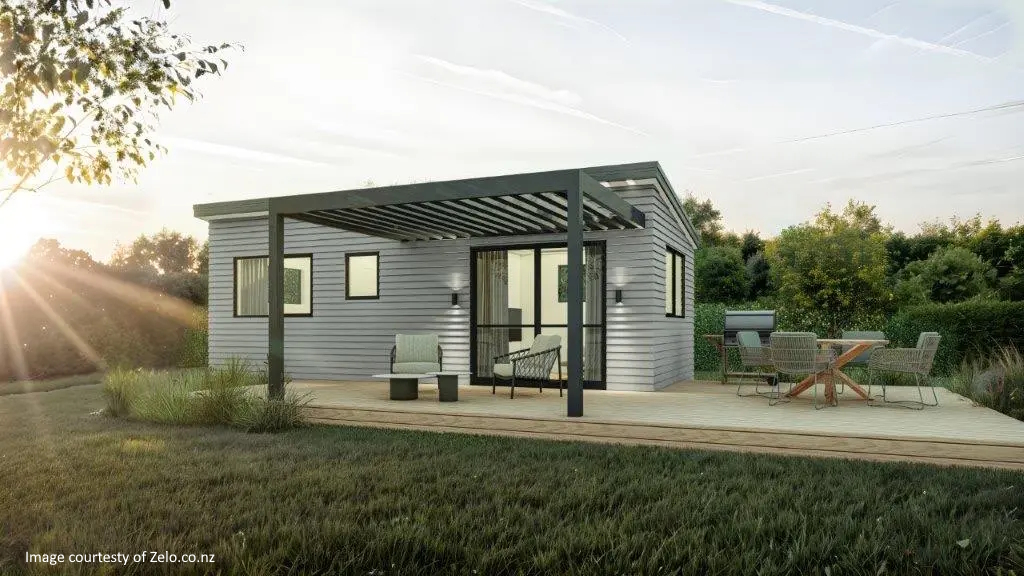
by Brendon Shervell||Tiny home
Powering a tiny home: what size system do you actually need?
The first question I get at every tiny home stand is "how big a system do I need?" And my answer is always the same. It depends less on the size of your house and more on 3…
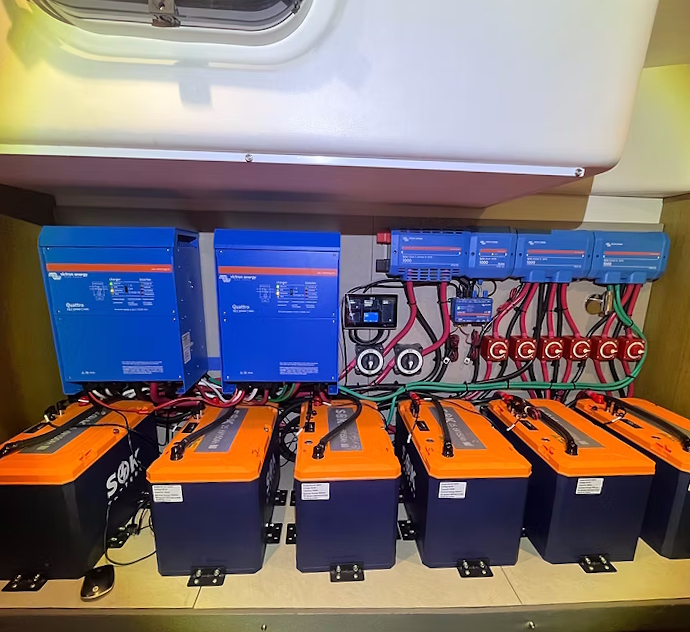
by Sogen Energy||Marine
Our certified marine lithium battery is here: the SOK 24V 150Ah Marine
The SOK SK24V150PH-Marine is a 24V 150Ah LiFePO4 house battery, tested and certified to AS/NZS 3004.2. It's in stock in New Zealand and on sale now.